
Just open any news source and a considerable amount of publications about fictional characters will sprout up—without distinction of priority and among the information from the real world: what maneuvers led these elements, said to be imaginary and originally aimed at children and young people, until they gained such importance, even among adults in modern society?
Regardless of whether it evolved or was created, there was a time when, faced with an urgent need for communication, humanity decided to record information on the walls of caves.
Considering that letters are glyphs (or drawings) that immediately evoke phonemes and the consequent formation of words, it is important to highlight that this article will primarily focus on drawings which, unlike letters, can express ideas and concepts far beyond a single word, being able to present a complete narrative in themselves.
ATTENTION:
TARGETED CONTENT EXCLUSIVELY
A Christians who believe in the Scriptures
DRAWING THROUGH HISTORY
Without any intention of providing entertainment, the visual representations called "cave paintings" present records of animals, hunts, natural phenomena, rituals, and a whole variety of data that even allow anthropologists, through iconographic studies, to gain a better understanding of these cultures.
Moving forward in history, we will find the Babylonian cuneiform — writings from five thousand years ago, discovered in 1929 — whose records, although symbolic, were not exactly iconic and lent themselves to the registration of goods and the formalization of contracts… activities that were not at all childish, by the way.

But they contain phonetic meaning!
Further on we will encounter the famous ones. hieroglyphs, considered enigmatic, difficult to understand, and although they are part of other civilizations, they were more widely used by EgyptiansBecause it was considered sacred writing, it was used only by priests, royalty, and scribes, who held the power to interpret and reproduce the symbols.
The Egyptians called hieroglyphs medju-netjer — meaning "words of the gods" — and used them only for religious purposes, such as on temple walls, tombs, or sarcophagi.
SOURCE: MEANINGS
According to Egyptian mythology, it was the goddess Seshat who created the hieroglyphs, and the god Thoth who taught them this language.
The belief in their magical powers was so strong that they believed that a person's name, when written in hieroglyphs, embodied all the energy and soul of that being: if the name were damaged, the person's identity would be lost.
For this reason, pharaohs usually destroyed tablets bearing the names of succeeding emperors or their enemies.
Hieroglyphs were expressed through symbols and drawings, capable of representing ideas, concepts, objects, animals, and even emotions or feelings, however—certainly and despite the precocity of some pharaohs — they were far from being used for children's daily entertainment or education.
IN THE NEWSPAPER
Many centuries have passed, and society has shown very little interest in creating entertainment content exclusively dedicated to children. When not engaged in activities currently prohibited, young children have to use their toys—or even books!—to distract themselves. We can cite the flourishing of stained glass and religious artwork as an example, because although they were designed, they only depicted episodes that were supposedly known to any human being, regardless of age.
This situation persisted until 1895, when the American Richard Outcault, likely linked to and supported by Freemasonry, he launched his "Yellow Kid," a boy always dressed in yellow pajamas who lived in the ghettos of New York: using a narrative with simple language (and often full of symbolism, as in the image below), he denounced the social issues present at the time.
Such is the symbolism contained in this "simple image to amuse children" that it even received a detailed explanation—which, even without knowing many specific terms, I attempted to translate—from one of the major American Masonic lodges:

Richard F. Outcault, Hogan's Alley. New York World, September 13, 1896.
References are made to many fraternal organizations of the time: the Elks; Odd Fellows; Shriners, Freemasons and Scottish Rite, all being parodied in signs and posters: “The Elx”, “Auld Lang Swine”, “Nights of Saint Chames Grand Lodge”, “Ancient Order of Sons O Guns”, “Tent of the 33rd Degree, it’s a tough game of poker here if you put money in it”, “All On De Square”, “In Hoc Signo Vinces”, “Ancient Order of the Contented Handshakers” (unlimited);
SOURCE: GRAND LODGE OF BRITISH COLUMBIA AND YUKON
Mickey Dugan, the Yellow Kid, wears a Knights of Columbus hat and a headband that reads "Hod Fellers";
The candidate for initiation is riding a goat on a terrain where the words "The Sands of the Desert" are engraved;
Two characters wear aprons drawn with a set square and compass, while another wears a red Shriner fez (hat?) with a tassel;
One poster shows a pair of intertwined hands, and another displays an all-seeing eye inside a triangle.

A“Order from Chaos“"Far from being planned by perishable human beings, its seeds are strategically planted generations in advance and, as considered in this study, appears to be constructed by..." entities whose existence transcends centuries and implement the necessary transformations across generations, ensuring that each generation sees itself acting for good... unable to foresee the terrible end products resulting from the sum of its actions.
Perhaps Outcault and the newspapers of his time believed they were creating and promoting genuine children's entertainment, but the number of not-at-all subliminal messages presented—such as the goat next to the Yellow Kid or the image above—points to something else…
THE MAGIC FLUTE, BY MOZART,
It was also interspersed with
COMPLEX MASONIC SYMBOLISM
HEROES
Now, in those days, and also for some time afterward, there were giants on the earth, when the sons of God came in to the daughters of men and they bore children to them. These giants were the heroes of old, men of renown!
(Genesis 6:4 – KJA)
The creation of comic strips intensified at the beginning of the 20th century and, basically, presented comedic and humorous content until the 1930s, when the first adventure stories and the beginnings of the character that would become the first superhero emerged.
In 1932 Jerry Siegel e Joe Shuster, Two Jewish men began producing what would be recognized as one of the first publications of the genre — Science Fiction: The Advance Guard of Future Civilization — and, the following year, the first version of the character was released, originally conceived as a villain with psychic powers, used to manipulate other people and dominate humanity.
In 1933, comic books in the United States were not yet as popular and their content was based on newspaper strips, so Siegel rewrote "Superman" as a hero, distinct from the villain created the previous year.
In the following years, the character underwent a series of reformulations at the hands of the two authors, who began offering it to various companies, always with negative results, until in 1938 "National Periodical Publications" invited them to contribute a new character to National's latest publication: they presented Superman and, once approved, they began cutting and pasting newspaper strips from the samples they had and transformed them into the pages of a comic book.
SOURCE: Wikipedia

They will say that this is just another of the many coincidences of so-called "conspiracy theories," but the original concept of Superman was too much in line with the biblical definition for that moment in history and risked losing effectiveness in the final revelation for which it was created—not by its supposed authors!—to contribute: it was necessary to introduce, to cloak it in a Judeo-Christian "smokescreen" to guarantee its acceptance by capitalist society, both American and global, in the coming years.
Some believe that Superman was inspired by Jewish mythology.
The British rabbi Simcha Weinstein He notes that the story of Superman has some parallels with that of Moses; for example, Moses, as a baby, was sent by his parents in a reed basket to escape death, being adopted by a foreign culture. Weinstein also posits that Superman's Kryptonian name, "Kal-El," resembles Hebrew words. קל-אל, which can be understood as "the voice of God".
The historian Larry Tye This suggests that this "Voice of God" is an allusion to Moses' role as a prophet.
The suffix “el” — meaning “(of) God” — is also found in the names of angels (for example, Gabriel, Ariel), who are humanoid, flying, benevolent beings with superhuman powers. The Nazis also thought Superman was Jewish and, in 1940, Joseph Goebbels He publicly denounced both Superman and his creator, Jerry Siegel.
That said, some historians argue that the evidence of Jewish influence in the original stories is merely circumstantial: Siegel and Shuster were not practicing Jews and never acknowledged the influence of Judaism in any memoir or interview.
Superman stories have also occasionally featured Christian themes: the writer Tom Mankiewicz He intentionally portrayed Superman in the 1978 film starring Christopher Reeve as an allegory for Jesus Christ: baby Kal-El's spaceship resembles the Star of Bethlehem, and Jor-El gives his son the messianic mission of leading humanity to a better future.
SOURCE: Wikipedia
In fact, all this discussion ends up taking on a passionate character and leading us — I ...and many others of my generation—seeing the character as an individual to the point of honoring him, naming their own children "Kal-El" or variations thereof... and, unfortunately, this only reveals how successful the true inspirers of this whole concept were.
I will return to the subject of this important first hero shortly, as he merely opened the door for the emergence of other "heroes" with far less noble characteristics than his own.
RELIABILITY
Since paper lacks the power to defend itself when used to publish obscenities, images of scantily clad women and various characters of dubious character began to be used in an attempt to avoid the sharp decline in comic book sales that occurred in the 1950s.
Featuring numerous citations from published magazines alluding to violence, sex, drug use, and other adult topics, in 1954 the psychiatrist Fredric Wertham launched his best-known book, “Seduction of the Innocent“"suggesting that comic books were dangerous for children, including citing the possibility that Batman and Robin had a homosexual relationship and that Wonder Woman, a heroine traditionally presented as heterosexual and a virgin, had a context (even well-documented) of 'sexual servitude'—a possibility admitted by the character's own creator.", William Moulton Marston — and that her strength and independence characterized her as a lesbian.

Dr. Wertham's claims were based on his experiences treating juvenile delinquents, where he concluded that the responsibility for the problems presented—such as increased crime, delinquency, and deviant sexual behavior—was a direct influence of comic books, a product consumed by most of his patients.
These criticisms contributed to the creation of an inquiry into the comic book industry in the United States Congress, the result of which was the creation of... Comics Code Authority, a code that regulated the publication of comics — modifying everything from the choice of colors and words to prohibiting, among other themes, sexual innuendo, violent images, horror stories, and mentions of corruption — through the provision of a publication permission stamp.
Because it was a private initiative — created by the publishers themselves as a form of self-censorship of content — the code had no legal authority, but the concept of moral control was widely accepted by the population and, therefore, distributors refused to sell magazines that did not have the seal stamped on their covers.
In the 1960s, under the influence of the United States, the four main Brazilian publishers — Abril, RGE, EBAL, and O Cruzeiro — created a code called the "Code of Ethics," which featured a seal similar to the American code — stating "Approved by the Code of Ethics" — on the covers of comic books.
This voluntary certification process was crucial in giving parents almost institutional credibility in comic books, trusting that any child with a comic book in their hands would be safely having their creativity stimulated while simultaneously exercising their reading skills.
The fact is that, over time, this seal lost its strength, and the first to stop submitting its comics for approval was Marvel, followed by other smaller publishers until, in 2011, DC Comics decided to create its own classification and, through this, decree the end of the code in a practically invisible way, without major warnings that our children had become targets of any influences that comic book authors might desire.
This maneuver reveals the shrewdness of the enemy we are dealing with: by anticipating the issue and creating an "internal body" to regulate content, they avoided the creation of an external regulator and sold an appearance of goodwill and integrity. Now, without any limits, all possible complaints can only be directed to the authors and editors themselves who intentionally created and published the subject matter of the complaint…
LOCKED UP WITH MONSTERS
An art teacher from Villa Lobos State College, In Salvador, Bahia, a teacher ordered 37 sixth-grade students (all between 11 and 12 years old) to close the doors of a classroom and, to prevent other people from entering, to prop them open with chairs.
SOURCE: BNews, on 11/23/2021
She then determined that the children had to kiss to earn R$ 10.00 and extra points, with even more points awarded if the kiss was between children of the same sex: some students panicked, refused to participate in the proposed activity, and recorded the incident with their cell phones, but the principal stormed into the room, took the devices, and simply deleted the recordings.
Some victims reported that the same teacher had done the same thing in previous years without any action being taken.

Before returning to the topic of "comics," I would just like to register some comments and questions regarding this catastrophic episode where a public official used the powers he was given to entice minors to commit lewd acts, offering illicit advantages and, because it involved money, encouraging prostitution (Click on the "+" sign below to read.):
This episode allows us to draw a perfect parallel between the degeneration of society and that of comic books, because while parents assume their children are safe, authors can claim they are promoting politically correct and inclusive actions by "stimulating" children through new experiences with diversity…
CONSECRATED BY MONSTERS
Bearing in mind that the code of ethics was being removed without many parents being aware of it, Douglas Wolk, the author of “Reading Comics: How Graphic Novels Work and What They Mean”"(Reading Comics: How Graphic Novels Work and What They Mean)," he told The Atlantic in a 2009 article about Alan Moore:
If you can create a symbol that will take root in someone's mind, then you're doing magic.
SOURCE: THE ATLANTIC
Right now, for example, they are preparing to make "Iron Man II," and in that sense, you can look at Iron Man as a spell cast 45 years ago that is only now coming true.
We're talking about pop culture: put your idea in front of many eyes and congratulations, you've transformed the world.
For those unfamiliar with Alan Moore, here are more excerpts from the same article that may serve as an introduction:
Moore is a comic book WRITER. In other words, he doesn't draw the figures, Although the hallucinatory specificity of his scripts is proverbial in the comic book industry: for the first panel of Watchmen, his instructions to the artist, Dave Gibbons, reach almost 700 words — “Liquid fingers of blood, thick and scarlet, run down the curb wall… garish streaks of bright red against the concrete gray of the stone…”.
If part of the mission of comic book writers over the last 30 years has been to recover and reinterpret a previous, seemingly exhausted, symbolic world, then Moore was the high priest of this postmodern ritual.
This might be a good time to mention that Moore is also a practicing magician, meaning he performs rituals and summons entities; he and his team are dowsers, clairvoyants, remote observers, wandering within the hidden energy network supposedly outlined by the six churches of architect Nicholas Hawksmoor in London.
They meet not at editors' lunches, but on psychic tangents.
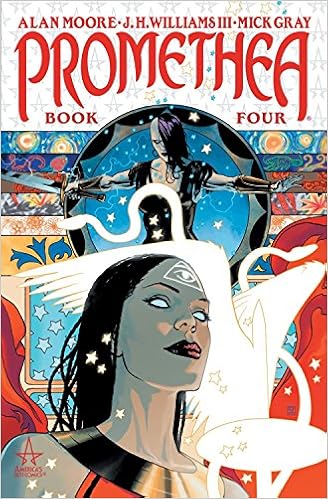
Moore's magic entered his writing in a more didactic way in Book Four of the Promethea series, where he offers readers a guided tour of the Kabbalistic Tree of Life, on whose branches we find perched 20th-century magicians such as Aleister Crowley and the late artist Austin Osman Spare.
The apparent paradox presented here – A funny postmodernist who worships at the altar of Glycon – that's not, within the world of comics, a paradox..
NO SECRETS
The revealing statement in that last sentence should be enough to put any Christian on alert, but we are already in a time when evil no longer needs to hide and, on the contrary, disguises itself with desirable names — progress, culture, freedom — and camouflages the sordidness of its gospel as proposals for “exercising the imagination” or similar things…
I honestly considered translating the entire interview that Alan Moore gave to the Arthur website in 2003, but due to lack of resources (time is money and vice versa) I will only publish the crucial paragraphs here.Click on the "+" sign below to read.):
Like the author Daniel Pinchbeck As highlighted in Arthur's debut issue last fall, magic is happening in the world.
Whether you think of magic as a powerful metaphor, as a notion of reality to be literally considered, or a voluntary self-delusion of losers and New Age housewives… it doesn’t matter: magic is here, now, as a cultural force—Harry Potter, Buffy, Sabrina, Lord of the Rings, Jedi and, of course, Black Sabbath—as part of our daily rhetoric and, perhaps, if you are so inclined, as something truly perceptible, in the same way that love and suffering are real, but not quantifiable.
Magic is here, and it's the witching season, and without a doubt, the most famous publicly acknowledged witch—or wizard, or magician, or shaman—in the Western world is the English comic book author Alan Moore.
You may know Moore from his mid-1980s creation, Watchmen, an extremely dark and exquisitely structured mystery story, created with artist Dave Gibbons, which addressed, among other themes, superheroes, Nixon-Reagan America, the argument that "the ends justify the means," and the nature of time and space.
Watchmen was a commercial and critical success, winning several awards and making Moore—a tall, similar-looking man—a star. Rasputin — a semi-pop star for a few years.
ArthurHow did your interest in developing your sorcery begin? How has becoming a mage affected the way you approach your work?
Alan Moore: Brian Eno observed that many artists, writers, and musicians have an almost superstitious fear of understanding how what they do for a living works. It's like being a driver and being afraid to look under the hood, afraid it will disappear. I think many people want to have the talent to compose or anything else, but they think, "Well, it's better not to examine this too closely, or it might be like riding a bicycle – if you stop and think about what you're doing, you'll fall.".
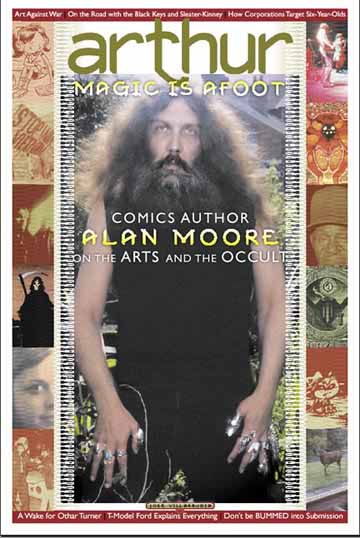
ArthurYou work primarily with comics, which is interesting, as are so many magicians… — Wizards? Sorcerers? — who were involved in the visual arts in the last century.
Alan Moore: One of the main hidden ideas of the early 20th century, which is also interesting because it was a scientific idea, was the sudden notion of "“fourth dimension“which was even a buzzword at the turn of the last century. (…) This fostered a strange encounter between scientists and spiritualists, because scientists and spiritualists realized that many of the key phenomena in spiritualism could be completely explained if you simply invoked the fourth dimension!”
Two pieces of wood made from different materials, two wooden rings, different types of wood, but which in spiritist sessions can intertwine... probably.
This was something called "stage magic," and the idea of a fourth dimension could explain it: how can you see inside a locked box? Or a sealed envelope? Well, in terms of the fourth dimension, you could. Just like three-dimensional creatures can see the inside of a two-dimensional square. They are looking from above, from a dimension that two-dimensional individuals wouldn't have.
ArthurWhat is the advantage of recognizing that what an artist, or simply a human being, does is magical in some way?
Alan Moore: Magic has given me both an understanding of my own creative processes that I didn't have before, and new ways to access them: all my performances have been born from magical rituals.
There would be an initial magical ritual where we would wait for divine inspiration or something else to tell us what to do.
And so, having received what we thought were our instructions, we followed them to the letter.
I am very pleased with the results this has yielded: these are things I wouldn't have created if I hadn't approached the work in this particular way.
I would say that I am doing more work now than I ever did before, even when, in my twenties, I was a young and elegant gazelle leaping over the precipices of my imagination. I think I am currently producing much more work and also becoming more satisfied with its quality: I have done some things in the last few years that I could never have imagined doing before.
ArthurSeriously? But you did Watchmen before you were a magician. And From Hell…
Alan Moore: Having done Watchmen — and particularly From Hell — I felt that perhaps I was reaching a limit in terms of what I could understand about writing rationally, that if I were to go any further in writing I would have to take a step beyond the rational… and magic was the only area that offered a place to step after that step.
Magic also seemed to offer a new way of seeing things, a new set of tools to carry on with: I know I couldn't keep making Watchmen repeatedly, any more than I could keep making From Hell repeatedly… I also know that back then I could never have done anything like, say, Promethea, which is an incomprehensible piece of construction… and I wouldn't have been up to it.
It's not that I never did anything good until I discovered magic, but discovering magic, or at least my understanding of it, gave me a bit more insight into how I did those good things.
ArthurLet me offer a little perspective here. Before '93 or '94, you considered yourselves an atheists. But you already knew a bit about the occult, judging by some of your stories and characters…
Alan Moore: Well, yes, but again, as a writer, I have to be interested in everything.
So yes, I was at least as knowledgeable about the occult as any fantasy comic book writer has to be, but it was just one of the things I was interested in… and it was something theoretical. My interest in the occult was “I’m interested in what people believe,” because those were the terms in which I saw it, and there was no way I could tell if what those people believe has any basis or validity.
What was interesting to me was that people believed in these things. (…) And these are Gnostic experiences: you either had them or you didn't.
⚕
For example: in my first experience — and this is very difficult to describe — I felt as if a very close friend and I were being taken on this journey by a specific entity.
The entity appeared to me, and to my friend, to be… to be that 2nd-century Roman cobra god called Glycon… or that the 2nd-century Roman cobra god called Glycon is one of the ways in which this type of energy is sometimes known.
Because the snake, as a symbol, runs through almost all magical systems, all religions: in yoga systems, you have the Kundalini serpent; in the creation myths of the Amazonian Indians, you have countless snakes that participate in creation… the same with the Bible and the serpent in the Garden of Eden; the Midgard serpent circled the world three times!
It's difficult to find a religion that doesn't have a snake somewhere in it.
⚕
When you discover that you've spent at least part of a night talking to an entity that tells you it's a demon. Goetic The specific thing that was first mentioned in the Book of Tobit, in the Apocrypha… there are so many ways you can interpret it.
The most obvious explanation is that it must have been some kind of hallucination—or that there was some kind of mental breakdown or something similar—and that would be a good explanation if there weren't other people with you who had similar experiences at the same time.
So, when you assume that this was some kind of real experience, then you have to reflect on whether it was something purely internal—some part of me that I gave a name and face to and projected in some way?—or was it some totally external entity that really was what it said it was and was talking to me? That's possible.
⚕
For me, the IDEA of God IS God (himself)... no matter what form he takes!
This is one of the problems that, for me, Christianity has… and Christianity has some lovely concepts! Beautiful concepts.
However, Christianity also insists on a historical Jesus, and if it were ever proven that Jesus did not exist, all of Christianity would fall apart. There is no reason for this, but it would, because they insist that this was DEFINITELY real, he was DEFINITELY born of a virgin, he DEFINITELY died on the cross, and then DEFINITELY physically ascended to heaven.
All of this sounds like nonsense to me. It sounds frankly impossible. This can't happen.
However, you have this wonderful story with complete integrity: as a story, that's fine, as it's rich in symbolism and moral awareness, but the insistence on this historical backdrop is the problem.
SOURCE: ARTHUR MAGAZINE
Now if it is proclaimed that Christ has been raised from the dead, how can some of you say that there is no resurrection of the dead?
(1 Corinthians 15:12-19 – KJA)
If there is no resurrection of the dead, then not even Christ has been raised;
And if Christ has not been raised, our preaching is useless and so is your faith.
Worse than that, we will be considered false witnesses of God, because we testified against Him that He raised Christ from the dead.
However, if it is true that the dead are not resurrected, then He did not resurrect Christ either.
For if the dead are not raised, then Christ himself has not been raised!
And if Christ has not been raised, your faith is futile; you are still in your sins.
Therefore, those who have fallen asleep in Christ are also lost.
If, then, our hope in Christ is limited to this life only, we are of all people most to be pitied.
In short, we have a man capable of preaching effusively about the happiness and productivity he gained after his experience with the serpent god, even admitting that he added fragments of witchcraft to his work even before his "conversion," but who declares himself incapable of believing in Christ because, even without concrete evidence to refute it, he cannot believe that He was real!
In the full interview, Alan Moore reveals the names of sorcerers who used magic to act through various artistic expressions, and this is quite curious information that I myself only discovered while researching for this text.
OBJECTIVES STATED
In fact, I came across such extensive and revealing content about openly demonic actions that it should make any true Christian, at the very least, exercise great caution when dealing with comics, knowing that they carry messages, true rituals, and other "gifts" such as this abominable statement by Grant Morrison—a publicly "rival" of Alan Moore—which I transcribe below:

Moore's pompous public declaration about his witchcraft may have been a motivating factor for Morrison to fully dedicate himself to the "occult comics" thing when he started "The Invisibles" in 1994. In terms of "magic," the two believe in very different things: Grant Morrison is from the "chaos magic" school, which practices magic less concerned with rules and rituals and more focused on trying to get things done.
“"Chaos magic" can be made from practically anything, as long as the intention is right: chaos magicians tend to like mixing elements from a whole variety of different cultures and histories to reinvent everything to suit their needs, finding no problem in doing magic for personal gain (or to change the world) and not just for human transcendence.
“"The Invisibles," with its 1500 pages (59 issues), is a masterpiece of occult literature written in comic book form.
Its convoluted plot tells a single long story (with several subplots) about a group of hidden rebels using magic to try to liberate humanity, opposing a cabal of dark magicians in positions of power and authority who attempt to use sorcery for control and oppression.
It is, quite simply, one of the greatest comic book series of all time.
According to Morrison, for anyone who wants to believe his word as anything more than a metaphor for chaos magic, he received parts of this story from aliens, when he was abducted by them in Kathmandu.
The entire story was intentionally designed to function as a kind of spell, intended to create powerful shifts in the consciousness of the reader.
Although "The Invisibles" doesn't yet have its own film or TV series (it's probably too strange and difficult to make), it has had a huge influence on a ton of science fiction and fantasy writers, as well as filmmakers: particularly, the creators of The Matrix were heavily influenced by "The Invisibles".
SOURCE: BREAK.COM (TRANSCRIBED IN THE PSYCHO PATH)
NO LIMITS

Long before the entire generation that witnessed the rise of comic books left this world, technology advanced exponentially to make them first animated and, more recently, personified in actors and through many films.
The illusion of innocence was shattered as characters originally created as expressions of good and morality were transformed by the companies that owned their rights: far from being individuals with personality and history, even the most powerful superheroes are nothing more than purely commercial entities, subject to endless "“retcons“, “multiverses” and “elsewords”"where they become murderers, perverts, obscene, traitors, necrophiles... or anything that serves to attract attention and increase sales.".

While Brazilian superheroes haven't developed the same market potential as those in foreign comics, almost everything offered as children's and youth entertainment on television has managed—in addition to obliterating any concrete references to Christianity—to include magical content disguised as "games" (see "“DPA – Detectives of the Blue Building“) or emotional appeal through communication with the dead (see, particularly, comments on, “The Valentines“…even the beloved Monica's Gang is showing signs that it will not be able to escape the evil dominion prophesied for these days:”
It's not a new thing that Mauricio de Sousa, the creator of Monica's Gang, has been challenged with the idea of a homosexual character.
While the children in the Monica's Gang universe are not sexualized, someone with that orientation could appear in Monica's Gang Young, for example. Or, considering the original gang, this minority group could be represented by the adults—for example, with a character being the child of a gay couple.
The public has no shortage of ideas, but Mauricio always tries to approach the subject with caution. This time, he spoke more openly about the potential project:

“"It's coming... I'm waiting a little while for the gay position to be more and more accepted, especially. I have a son who is openly gay, and I adore my son. He takes care of such an important part [of the company], which is the shows and performances. And it's a challenge for the older and more experienced people.".
There can be no obstacles to sensations. It's a way, an attitude, it's a word that escapes me now… — he hesitates, as if measuring his words — of behavior… It's not behavior either, the word escapes me.
But anyway, I think we all have the right to live what is pleasant, necessary, and good for us. But especially if it's good for more than one person, it's even better. I think it was a very good experience for me too.”
SOURCE: BBC News Brazil
When an unclean spirit goes out of a person, it passes through arid places seeking rest, but finds nowhere to rest.
(Matthew 12:43-45 – KJA)
Then he says, 'I will return to my house from which I came.'.
And upon returning, he finds the house unoccupied, swept, and tidy.
So he goes and takes with him seven other spirits more wicked than himself, and they go in and live there.
And that person's final condition becomes worse than the first.
The same will happen to this evil generation!
At the first vertex of creation we have all sorts of witches, sorcerers, magicians, members of (no longer so) secret and progressive societies openly sending everything from messages that once needed to be subliminal to unclean spirits carrying spells, all plotted to, as Grant Morrison explained, create powerful changes in the consciousness of the reader.
At the other extreme we find thousands, if not millions, of "unoccupied houses"—because anyone not inhabited by the Holy Spirit This qualifies as such — consuming contaminated content (from magazines, cartoons, or YouTube channels) without any supervision, trusting that they are being encouraged to exercise their creativity: as we have seen, the fact that a message is presented through drawings does not automatically make its content safe.
Finally, at the very end of this "“triangle of intellectual possession“We will encounter the “let’s not make a fuss” crowd, composed of imbeciles with an air of superiority who, with each attack from the spiritual legions, run to shout that all this “is just fiction” or that there is no freedom of expression in a prejudiced society… or any of those politically correct slogans that have plagued humanity, allowing that…” prophecies concerning the end times may they be fulfilled exactly.

DON'T FORGET TO READ
THE GOSPEL OF THE DRAGON
Finally, we went through all this research to understand that the "innocent" comic books, since their creation, have never been as innocent as they would like to appear and should be, and unfortunately — just like the students locked up with the "monster of art" in Salvador — fans and readers of comic book characters, particularly the younger and more defenseless ones, can be attacked at any moment.
Thank you for reading this far, and I truly need any help you can offer: comments, shares, and reactions help spread this content, which was produced with the intention of contributing to the edification of the Body of Christ in the world.
A shortened and easy-to-remember link to this post is:
https://cutt.ly/figurinhas
 Português do Brasil
  English
  Español de Argentina